
What’s New for Spring?
What’s New for Spring?
“To a land flowing with milk and honey” (Exod. 3:8b).
We don’t produce milk on our property, but we do a new hive of bees. Also, we grow our own eggs!
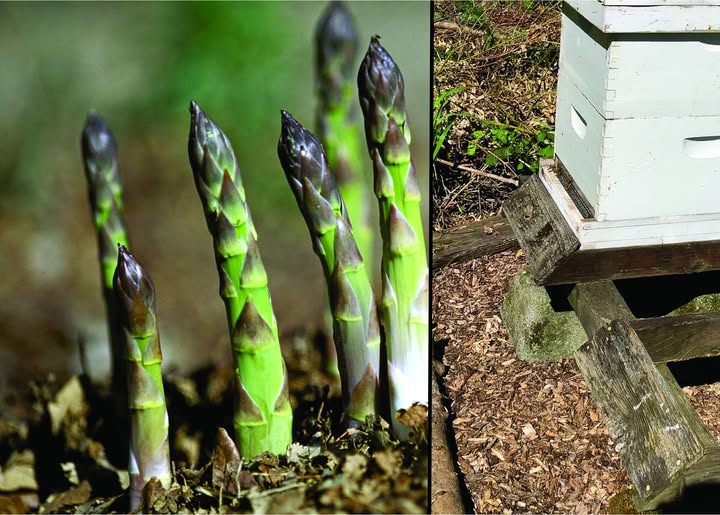
This combo picture shows our latest April adventures in the lowest half acre. I started harvesting asparagus and my daughter installed a new hive of honeybees.
We harvest from a patch we started over twenty years ago. Every April we cut succulent spears and feast on fresh asparagus for about six weeks. After that, we let the spears mature, blossom, and go to seed. The seeds sprout and fill in the patch (after the sprouts’ fourth year they’ll produce spears for the table). Also, the mature stalks labor all summer storing their energy in the root cluster for next Spring’s harvest.
After a lengthy hiatus, Halcyon decided to dive into apiary participation again. No, I don’t mean she’s swimming with the bees! I mean she now has a new colony of honey makers.
Arduous and diligent preparation set the stage of installing the hive. First, she moved their location. The previous location exposed the bees to drifting spray applications by the neighbors. Bees at that location left us, not liking the conditions. They absconded taking everything with them!
We’ll see whether this new location provides sufficient isolation from the contaminants. In years past we had reasonable success with hives in this location. Though, beekeeping in western Washington poses significant challenges.
Then, on Sunday, April 14, she carefully opened a two-pound package of bees with queen and placed them into the hive body seen in the picture. When she examined the new colony about two weeks later, she found them making fresh comb and storing small amounts of nectar and pollen. It was too early to detect any new brood. We should see that sometime in early May. If you look carefully you’ll see two worker-bees on the far side of the landing lip, about ready to enter the hive.
In a previous life I kept bees in Moscow, ID, Spokane, WA, and Terre Haute, IN. In each location we had huge success. We kept the extractor busy in July and August! In each of these locations I could expect to take 150 pounds of honey from each hive each year. Here in Auburn getting 50 pounds per hive will be nice.
I tried to cleverly think of a “C” word to talk about, but it’s far to early to mention carrots! Though I did mention eggs, which require chickens. Thus, you have the A, B, & Cs of the MacArthur/McCollum farm!
Isn’t it great to enjoy the bounty of God’s great creation?
Rod MacArthur
206.949.0325